How to Tell if a Gemstone is Real | 7 checks you can do at home
You've bought a gemstone and something isn't sitting right. The colour looks a bit too even. The price was suspiciously good. Or you've inherited a piece and you simply don't know what you're holding.
I've been travelling all over the world buying gemstones (professionally) for over 25 years and I still get sent photographs every week from people asking the same question: is this real? The good news is that you don't need a gem laboratory to catch most imitations. You need about ten minutes, decent daylight and a £30 loupe.
Here are 7 checks you can do at home:
No single home test proves a gemstone is genuine but seven simple, non-destructive checks done together will catch the overwhelming majority of glass, plastic, dyed and moulded imitations. Look at temperature, weight, inclusions under magnification, gas bubbles, dye pooling in cracks, facet edge wear, and mould seams. Then ask the seller direct questions about origin and treatment.
Firstly, "fake" doesn't mean what most people think.
Before you test anything, it's worth being clear on the terminology, because a lot of panic online comes from people mixing them up.
Natural — formed in the earth by nature. Then cut and polished by humans. Nothing else has been done to it!
Treated — a natural gemstone that's been altered by humans. This includes heated, dyed, oiled, irradiated or stabilised. This is extremely common and not automatically a problem. For example, the majority of amethyst, sapphire and tanzanite on the market are heated. Most gems cut as beads and cabochons, sold for jewellery making are stabilised. Without being treated, the gemstone rough used to make beads & cabs would be too soft and porous to work with and would go to waste. What actually matters is whether the seller tells you this!
Synthetic (lab-grown) — The same chemical, optical and physical properties as it’s natural counterpart but it is grown in a factory. A ‘lab-grown’ sapphire is still aluminium oxide, still hardness 9. It isn't a fake sapphire. It's a sapphire with a different birthplace, and it should be priced accordingly.
Side note – ‘Laboratory grown’ is misleading, these gemstones are made in huge factories not a laboratories by scientists in white coats!
Imitation (simulant)— This is the one to watch out for! This is a material impersonating another material! Glass, plastic, resin, or a cheap stone dyed to impersonate a more expensive one. Dyed howlite sold as turquoise. Black glass sold as Whitby Jet. This is what the checks below are designed to catch.
So the real question usually isn't "is it real?" It's "is it what I was told it was?”
The most common gemstones I get asked to check are dyed or filled bead strands. People presume because the beads are cheap that no one would bother to mess with them but that is far from the case! When I'm sourcing gemstones in India and China, I commonly come across the latest treatments the market has created, because sellers practice these treatments on beads first before moving on to the more expensive gems. They're usually taking material that would otherwise be unsellable and giving it a small value… better than no value at all!
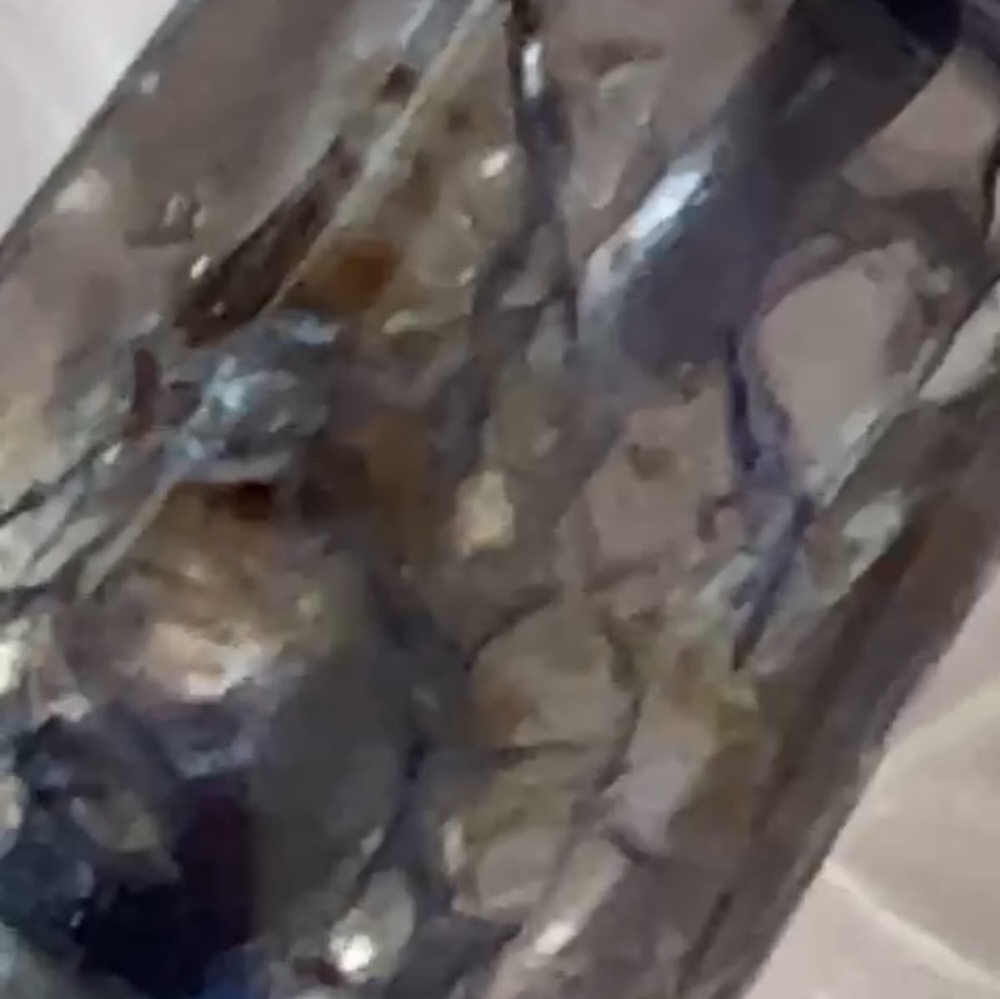
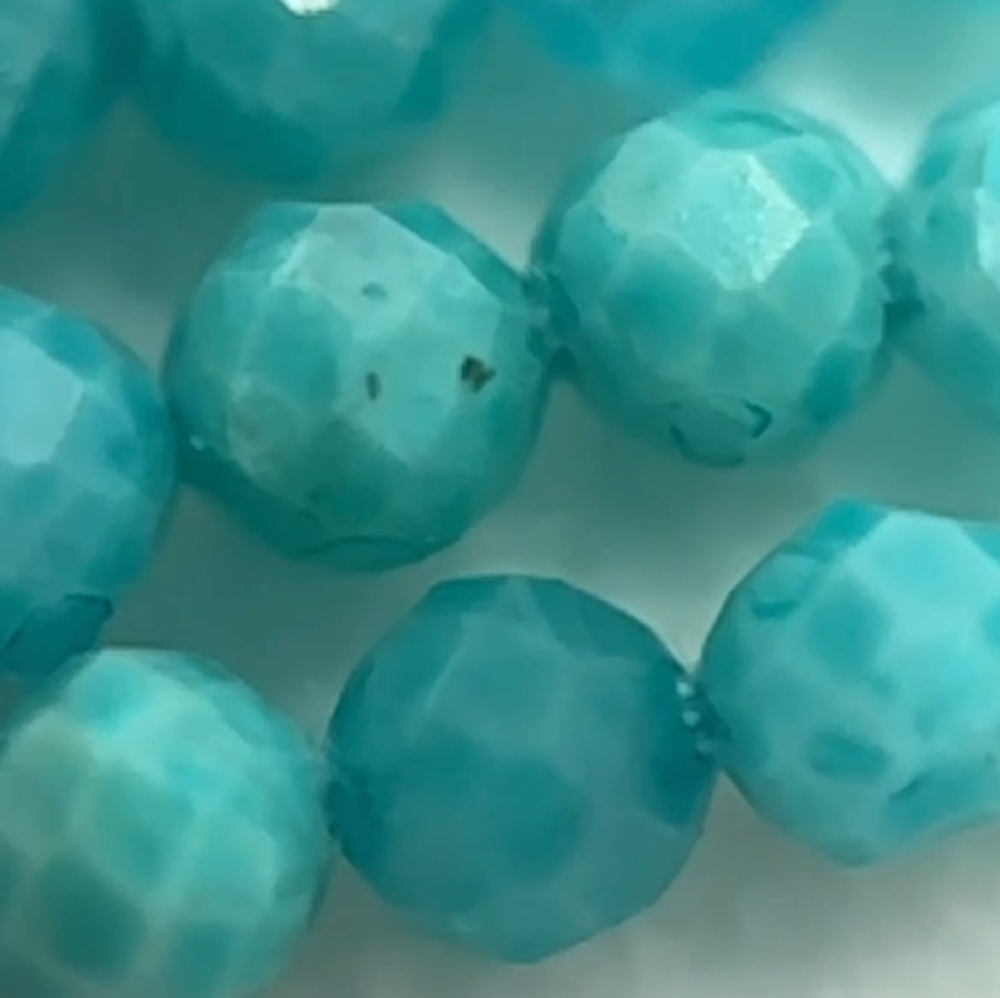
Dye pooling in internal fractures of Iolite and micro faceted beads
Check 1: How does it feel?
Pick the stone up and hold it against your inner wrist and just think about it.
Most crystalline gemstones conduct heat away from you, so they feel distinctly cool and stay cool for a few seconds. Glass and especially plastic warm up almost immediately and feel closer to room temperature.
This is a rough indicator rather than proof, it's affected by the size of the stone and how warm the room is, but it costs you nothing and it's often the first thing that makes me suspicious.
There are exceptions worth knowing about: Whitby Jet & Amber are biogenic ( was known as organic), not crystalline, and feel noticeably *warm* and light. If a "Jet" bead feels cold and heavy in your hand, you are probably holding what sellers call French Jet, which is black glass.
Check 2: Does the weight match the size?
Weight is one of the properties gemmologists use the most, and you can approximate it by hand. We call it hefting the gemstone!
Hold the stone in your palm and ask whether it feels right for its size. Plastic and resin imitations feel conspicuously light – like plastic. Some glass, on the other hand, is leaded and feels heavier than the stone it's pretending to be.
You'll get much better at this once you've handled a few hundred stones, which is why the best version of this test is comparative: put the questionable stone next to one you *know* is genuine, of similar size. The difference is usually obvious the moment they're side by side.
Check 3: What's inside the gemstone, under a loupe?
If you buy one piece of equipment, make it a 10x triplet loupe. They're around £30 and they will pay for themselves the first time they stop you making a bad purchase.
You can learn how to use a 10x loupe properly HERE
Hold the stone under a light and look through it at all angles, keep moving it, don’t just look straight down. Now move the stone in and out of the lighting conditions as each lighting condition will reveal something new.
In a natural stone you're hoping to see ‘imperfections’, we call these inclusions. Tiny mineral crystals. Feathers and fingerprints. Silk needles in ruby and sapphire. Faint angular colour zoning where the colour is stronger in one area than another. These are growth features — the stone's history — and they're reassuring. Each inclusion actually has it’s own name in gemmology.
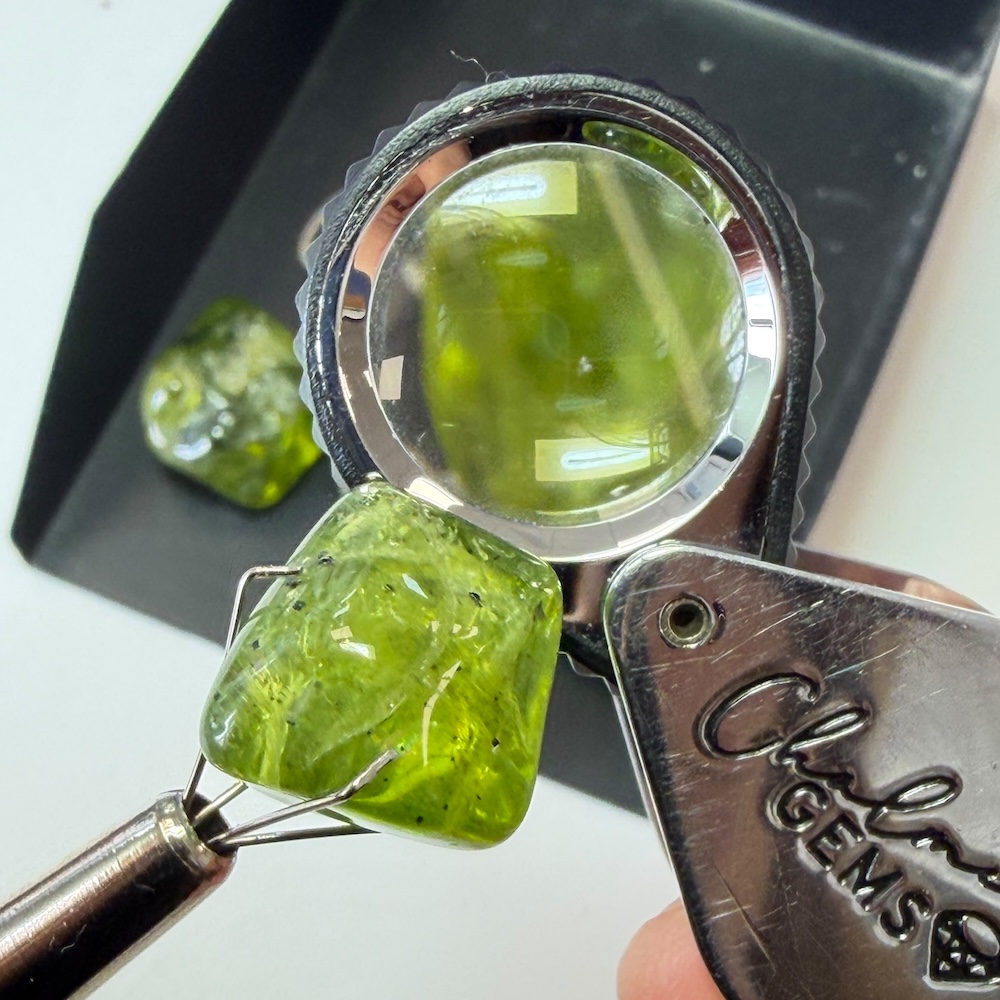
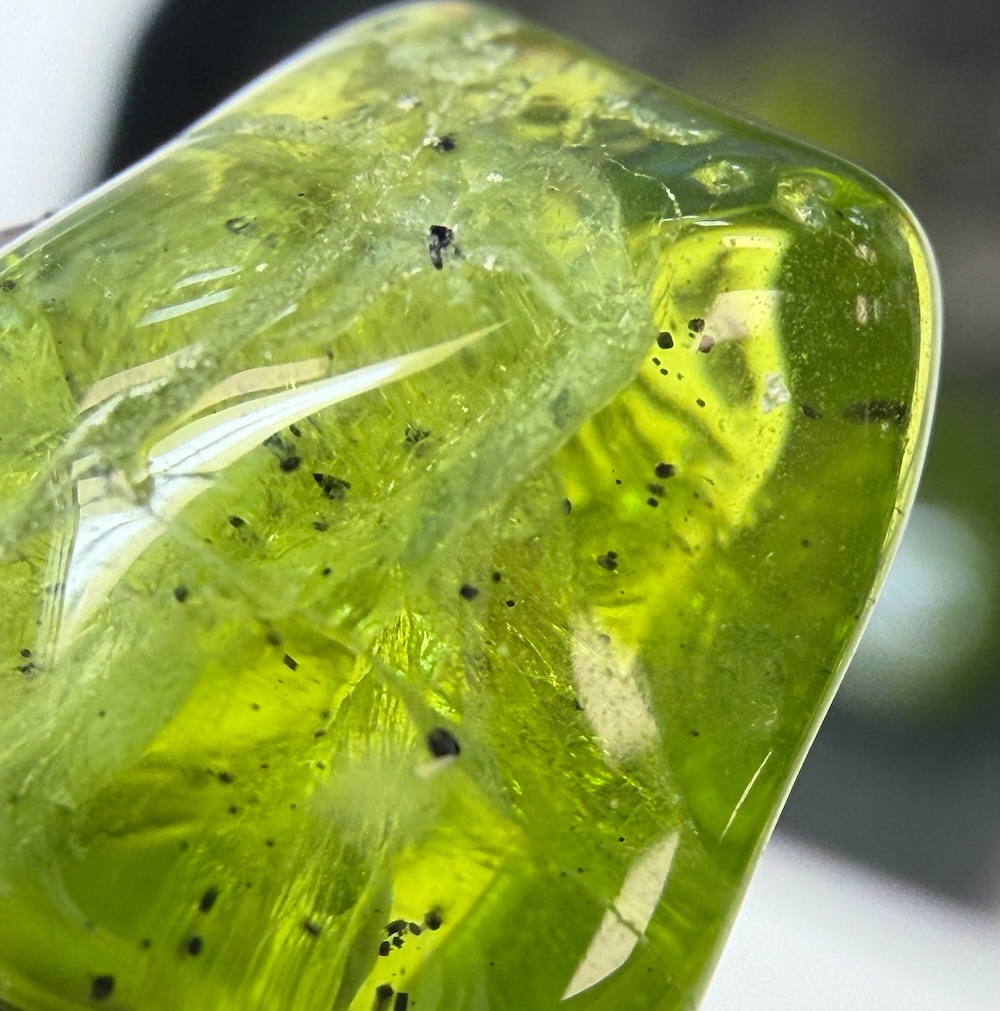
Peridot under the loupe. You can see inclusions including fractures and mineral inclusions.
A flawless, glassy, completely uniform interior is a red flag, particularly at a low price. Nature is rarely that clean. Remember, if it looks too good to be true it probably is!
When I use my loupe, I am looking for signs of nature. I want to see an indicator that the gemstone was made by mother nature…not human beings.
There are specific inclusions that can help identify the gemstone but that’s a blog for another day.
Check 4: Are there bubbles?
This one deserves its own check because it's the single most reliable giveaway for glass.
Glass is molten when it's formed, so it traps air. Under a loupe you'll see round or oval gas bubbles, sometimes in clusters, sometimes trailing in a curved line. You may also see swirls — flow structure, where the molten glass moved as it set.
Most natural gemstones don't contain round gas bubbles. They were never liquid in that way.
Bubbles also give away reconstituted stones: crushed material bound with resin and moulded into beads or cabochons. This is very common with cheap "turquoise", "lapis", "amber" and "jet". They're also sometimes present in composite stones. Materials that have been stuck together like doublets or triplets.
If you see clean round bubbles, it’s unlikely you are looking at a natural gemstone. That check alone is close to conclusive.**
I must caveat that with Amber and natural glass. Amber is created by slow flowing tree resin and may well contain bubbles and natural glass will contain bubbles.
Check 5: Where has the colour collected?
Dyed gemstones are everywhere, and the dye almost always betrays itself in the same way: the colour pools somewhere on the stone.
Look closely at cracks, fractures, drill holes and the porous seams in the material. In a dyed stone the colour will be visibly more intense there — a bright line of pigment sitting in a fissure while the surrounding stone is paler.
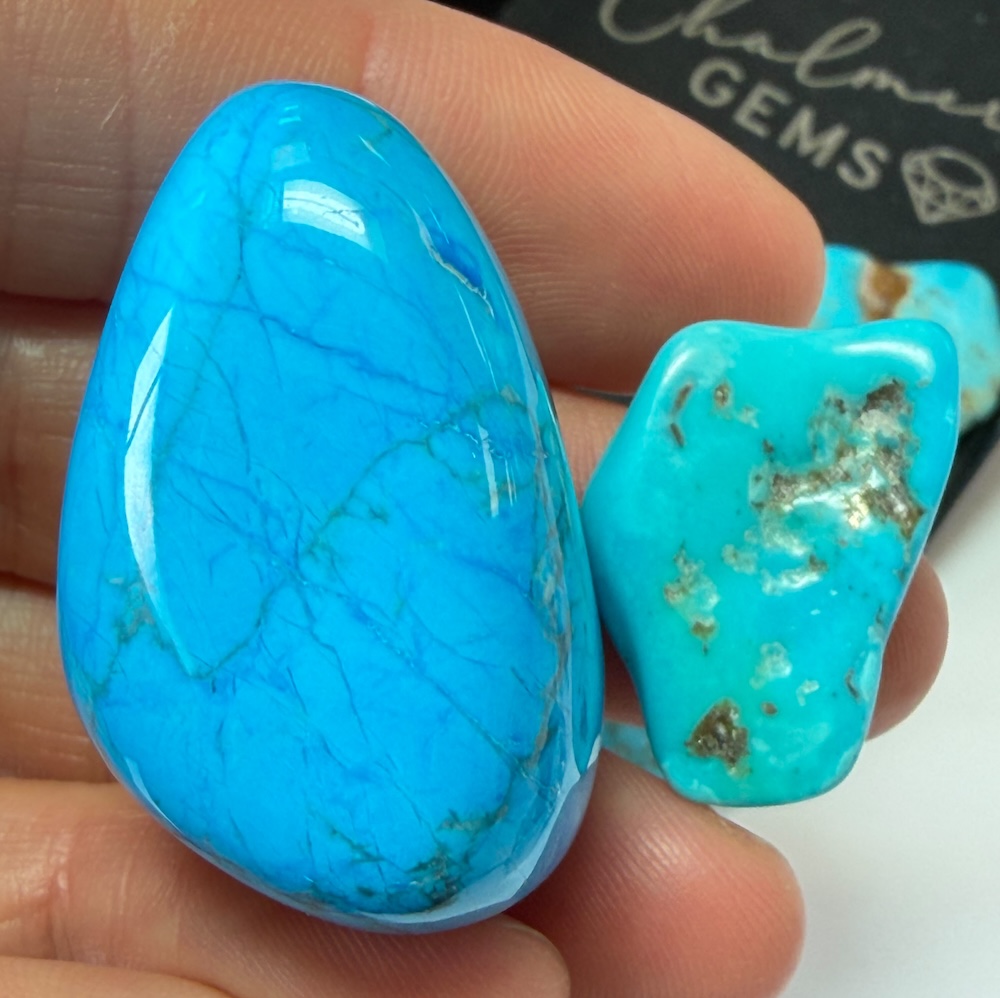
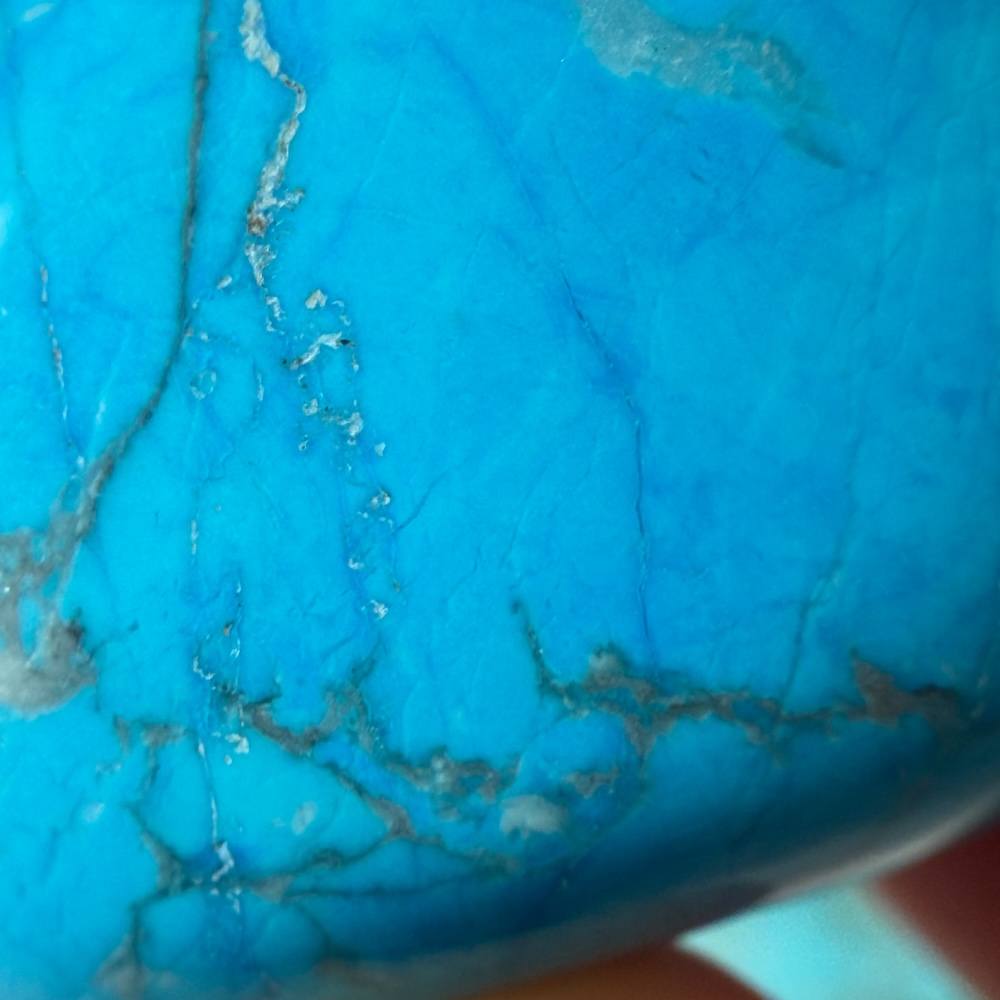
Dyed Howlite ( on the left) and natural turquoise ( on the right) under 10x loupe you can see the blue dye in the veins of the blue Howlite
Two more hints it’s dyed:
- Rub the stone with a cotton bud dampened with a little water. Poorly dyed material may transfer colour (do this on the back or an inconspicuous edge). This will not identify a well dyed gemstone but it is a good start.
When I travel, I can’t take all the equipment a Gemmologist would like to use. I have created my own travel gem kit which contains nail polish remover pads (easier to get through customs). These are a great tool to pull dye from a suspected dyed gemstone (again in an inconspicuous place).
- Look at a whole strand at once. Twenty beads with identical, flat, saturated colour and no variation is not how nature works. Genuine strands mostly have some variance in colour.
The classic case is dyed howlite sold as turquoise. Howlite is naturally white with grey-brown veining, and takes blue dye beautifully. Under a loupe, the dye sits in the veins rather than the veins being a natural part of the stone's matrix.
Check 6: Look at the edges and facets
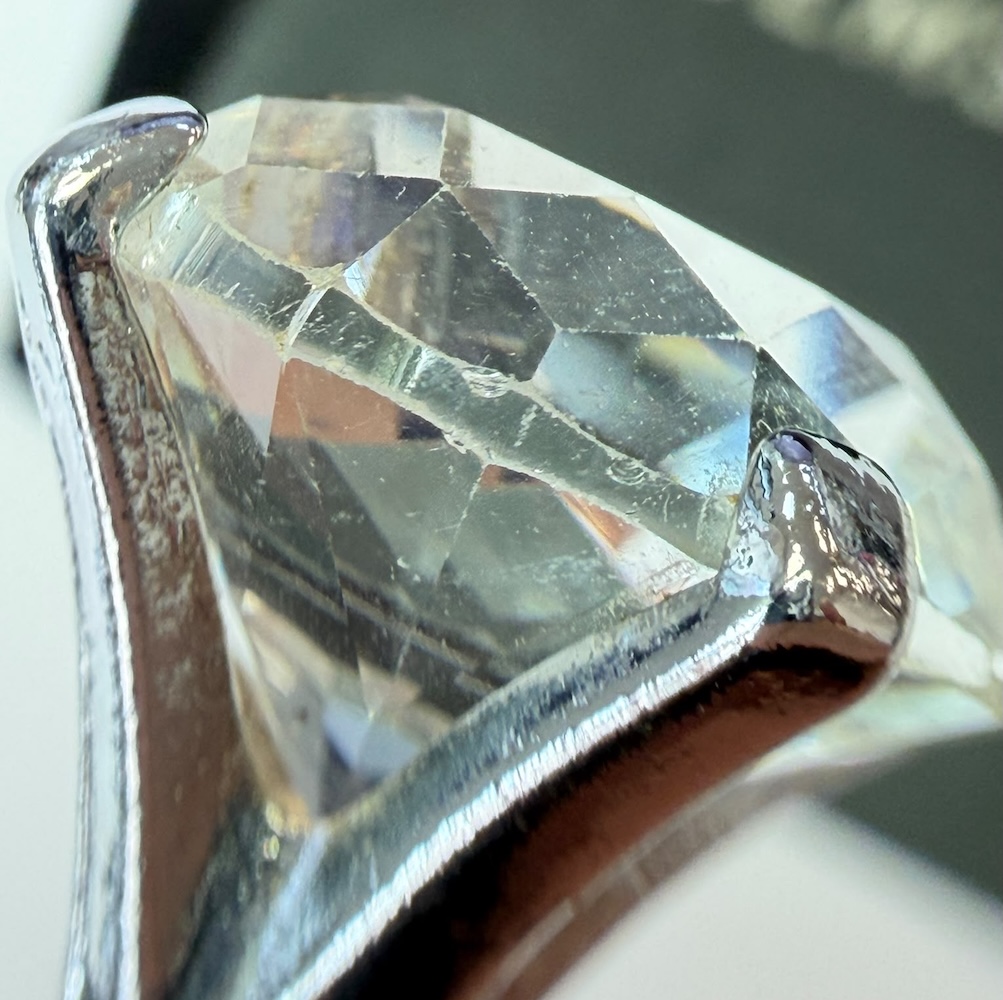
Most imitations are softer than the stones they impersonate. Glass sits around 5.5 on the Mohs scale; quartz is 7; sapphire is 9.
That difference shows up on the edges. On a glass imitation that's been worn or rattling around in a bag, the facet edges get rounded off, scuffed and slightly cloudy. On a genuine harder stone, the facet edges stay crisp and meet in sharp lines. A stone of value will be kept separate to others, so it doesn’t get damaged. If the supplier is letting them all rattle around he doesn’t see any value in his merchandise.
Check 7: Any sign it was made in a mould?
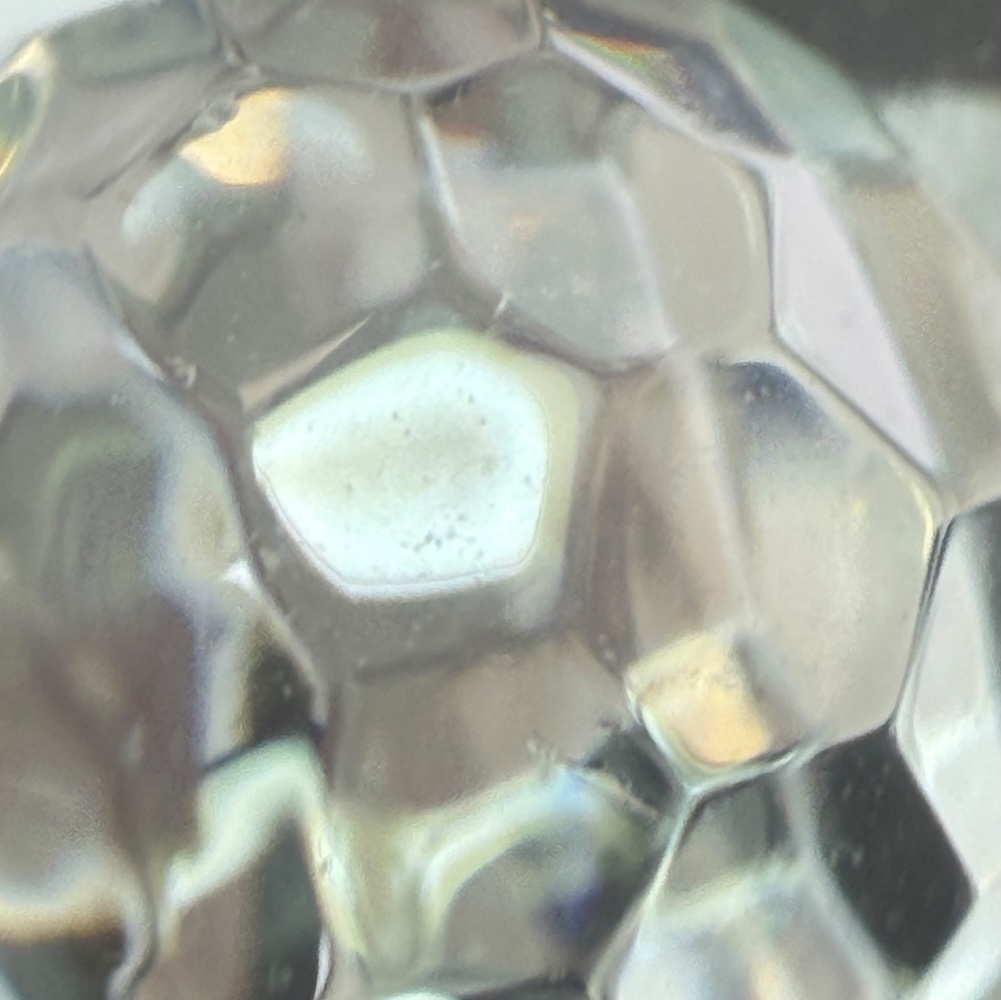
Natural stone is cut and ground. It cannot be poured.
So look for a seam — a fine raised or flattened line running around the widest part of a bead, or around the girdle of a cabochon, where two halves of a mould met. Check inside drill holes too, where manufacturers often don't bother to clean up.
Moulding marks are absolute. If a stone shows a mould seam, it was poured — it's glass, plastic or resin, whatever the label says.
If the natural gemstone has been cut or carved it will display evidence of that under your 10x loupe.
Which stones get imitated most and what gives them away
| Gemstone | Common Imitation | Clues to look for |
| Diamond | CZ | Rounded facet edges, too many flashes of colour from the surface. |
| Whitby Jet or any Jet | Black Glass | Light weight, no light passes through it, leaves a brown streak when pulled across a surface. |
| Larimar | Dyed Agate/Howlite/ Resin | Dye pools in the pattern. Repeat pattern. Bubbles |
| Moonstone | Opalite | Has a milky blue tint when light passes through. |
| Turquoise | Dyed Howlite | Dye pools in the veins |
| Amber | Plastic | Inclusions that look too perfect. When rubbed it smells of plastic. |
| Ruby | Glass | Surface and facet edges may be worn as glass is much softer than Ruby. Look for bubbles with loupe. |
| Emerald | Glass | Commercial Emerald commonly has a lot of inclusions, so look for a busy. Be concerned if the stone is free from inclusions. |
| Sapphire | Glass | Surface and facet edges may be worn as glass is much softer than Sapphire. Look for bubbles with loupe. Natural Sapphire has angular colour zoning, glass does not. |
| Diamond | Moissanite | Moissanite has a very slight green tint to it and is doubly refractive, it is an easy spot for a gemmologist. At home I would look at it verses another gemstone and it may look a little fuzzy due to it’s double refraction. |
The tests you should never do at home
You'll find these recommended online. Please don't.
Lick the gemstones. Putting a gemstone near or in your mouth is totally unnecessary. As well as that gemstones are polished and stabilised with chemicals, you wouldn’t to ingest anything dangerous.
The hot needle test. Heating a needle and pressing it into the stone to see if it smells or melts. It permanently damages the gemstone, and on an antique it destroys the value entirely. There's no result it gives you that careful observation won't.
Scratch testing. Dragging the stone across glass, or a knife across the stone, to judge hardness. You will scratch something, and quite often it's the good stone.
Acid or bleach. It damages the stone, it can be genuinely dangerous, and it tells you very little.
"Breathe on it" as proof. The fog test is mildly useful for separating diamond from cubic zirconia. It is not a general test for whether a stone is real, despite what the internet says.
If a stone matters to you financially or sentimentally, the right next step isn't a home experiment. It's a Gemmologist….find one and ask them.
The check that matters more than all seven: who you're buying from
Using a supplier you trust is the key to buying gemstones.
A good supplier will tell you, without being asked, what the stone is, where it came from, and what's been done to it. Stabilised turquoise should be described as stabilised. Dyed agate should be described as dyed. Lab-grown should be described as laboratory grown. None of those are dishonest products — the dishonesty is only ever in the silence.
Before you buy, ask three questions:
1. What treatments has this stone undergone? ("None that I'm aware of" is a much weaker answer than a specific one.)
2. Where was it sourced?
3. What's your returns policy if it isn't as described?
A seller who knows their material will enjoy answering these. A seller who doesn't will become vague.
At Chalmers Gems every stone is checked for authenticity before it's listed, because I test them myself. `[LINK: /how-it-works/]` We buy directly from cutters and manufacturers on our sourcing trips, so we know the route each parcel took to get here making our gemstones Responsibly Sourced.
Before you buy your next stone
Run through the seven checks, buy a loupe and ask your supplier the three questions above — how they answer will tell you more than any home test.
If you'd like to see how we check and source our stones, Find out more here and you can browse our current Gemstone Cabochons, Bead Strands and Pearls.
Not sure about a stone you already own? Send us a photograph, I'm always happy to take a look.

Written by Marie Chalmers FGA DGA
Marie is a Fellow of the Gemmological Association and Diamond Grader, and has worked in the gemstone and jewellery trade for over 25 years. She founded Chalmers Gems to give jewellers direct access to responsibly sourced gemstones, and is responsible for every gemstone the company sells. About us