
Labradorite
Everything you need to know about labradorite gemstones by expert gemmologist, Marie Chalmers.
Labradorite looks like an ordinary grey stone until you tilt it. Then a flash of electric blue, green or gold sweeps across the surface and disappears again.
Inuit legend says the northern lights were once trapped inside the rocks of Labrador, and it’s easy to see why.

What is Labradorite?
Labradorite is a plagioclase feldspar, a mineral that sits partway between two others: albite, which is rich in sodium, and anorthite, which is rich in calcium (NaAlSi₃O₈ – CaAl₂Si₂O₈). It crystallises in the triclinic system and usually forms blocky or tabular crystals, or masses that break cleanly along flat planes.
Its body colour runs from pale grey to almost black, and it can be transparent to translucent. What makes it famous is labradorescence: flashes of blue, green, cyan, purple, orange, yellow and, very rarely, red. These colours aren’t pigment. Inside the stone are extremely thin layers of two slightly different feldspars, and light bouncing between them is reinforced at some wavelengths and cancelled out at others. It’s the same effect as the colours on a soap bubble. This is why the flash appears only at certain angles and vanishes as you turn the stone.
Labradorite is 6 to 6.5 on the Mohs Scale of Hardness, so it resists everyday scratches well. Like Moonstone, though, it has cleavage. It can split along those planes if it takes a hard knock in the wrong direction, so good jewellery design protects the stone’s edges. It should also be kept away from heat and acids.
For more on how the flash works and what drives its value, read Marie’s 10 Must-Know Facts About Labradorite.
Rarity & Quality
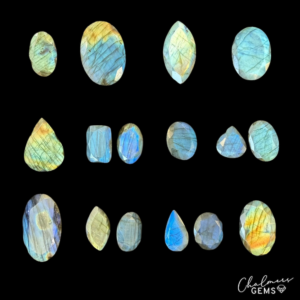
When you’re choosing labradorite, look at it the way it will be worn. The best stones show their flash face-up. A Cabochon that only lights up when you tilt it sharply sideways will look grey most of the time once it’s set. Check how much of the surface the colour covers, how bright it is, and whether it shows one colour or several. Blue is the most common. Gold, orange, purple and full multi-colour flashes are scarcer.
The most celebrated variety is Spectrolite, the trade name for labradorite from Ylämaa in south-eastern Finland. It has a very dark body colour and often shows the full rainbow at once.
Most labradorite on the market is untreated. The main thing to watch for is red feldspar sold as “andesine” or “red labradorite”. Much of that material has been coloured artificially by diffusing copper into the stone, so ask the seller directly.
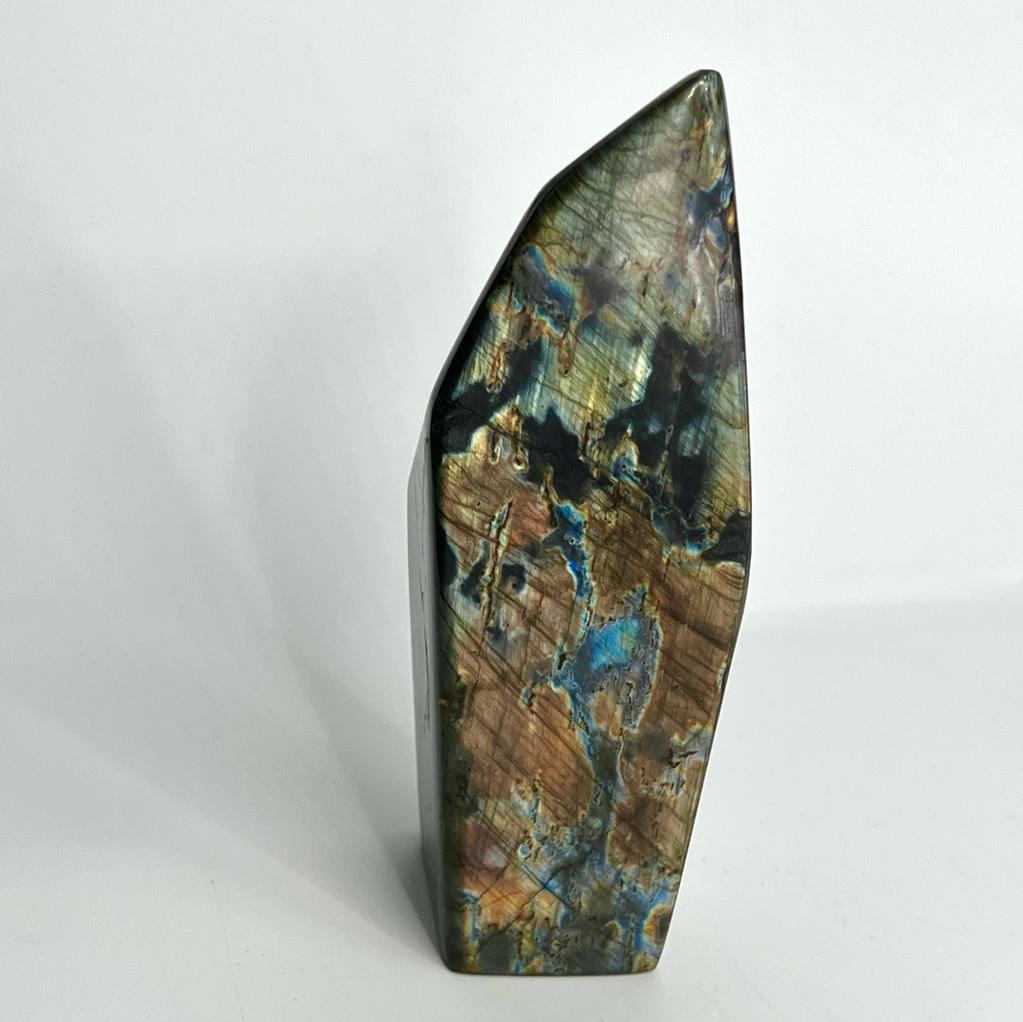
Spectrolite
Labradorite Through History
Labradorite takes its name from the Labrador coast of Canada. Moravian missionaries found it on the Isle of Paul, near Nain, around 1770, and sent specimens back to Europe, where the flashing stone caused a stir.
Long before that, Inuit legend said the northern lights had been trapped in the rocks along the coast until a warrior struck them with his spear. Some of the light escaped into the sky, and the rest stayed locked in the stone.
Finland’s Spectrolite has a wartime story of its own. In 1940, Pekka Laitakari found a deposit at Ylämaa while building the Salpa Line, a chain of defensive fortifications along the eastern border. His father, Aarne Laitakari, director of the Geological Survey of Finland, had spent years searching for the source of the stone. He named it Spectrolite for the full spectrum of colours it showed. Quarrying began after the Second World War, and Ylämaa is now known as Finland’s gem village.
Why Jewellery Makers Love Labradorite
No two pieces of labradorite are the same, so every design ends up one of a kind. The flash moves as the wearer moves, which makes it ideal for pieces that catch the light. Its grey body colour suits silver especially well, while gold brings out the warmer flashes.
Popular uses include:
- Cabochon pendants
- Wire-wrapped designs
- Beaded bracelets and necklaces
- Earrings
- Bezel-set rings (in protective settings)
- Carved charms and drilled pendants

Popular Labradorite Products
-

Labradorite Bead 3.5x2cm – Tear Drop with 2mm Drill Hole 1pc
£6.00 -
Labradorite Beads 4mm – Smooth Round Gemstone (38cm) Strand
£5.00 -
Labradorite Faceted Mixed Shape Cabochons – Select Your Own
£12.00 -
Labradorite Beads 5-8mm – Nugget Gemstone (38cm) Strand
£9.00 -
Purple Labradorite Mixed Shape Cabochon Approx 60 – 70mm 100 – 145 Carats
£89.50 -
Labradorite Beads 4-10mm – Tumble Gemstone (38cm) Strand
£11.00




Why does labradorite flash?
Labradorite is made of very thin layers of two slightly different feldspars. Light reflecting between those layers interferes with itself, strengthening some colours and cancelling others. The flash appears only at certain angles, which is why it comes and goes as you turn the stone.
What’s the difference between labradorite and Spectrolite?
Spectrolite is labradorite from Ylämaa in Finland. It’s the same mineral, but it usually has a darker body colour and a wider, more intense range of flash colours, often the full spectrum in a single stone. It’s rarer and more expensive than labradorite from other sources.
Is Rainbow Moonstone actually labradorite?
Gemmologically, yes. Most “Rainbow Moonstone” is a transparent, near-colourless labradorite rather than true moonstone, which is a different type of feldspar. The trade name is so widely used that it has stuck. Both are feldspars, which is why their glows look alike.
Is labradorite treated?
Most labradorite is natural and untreated. The exception to look out for is red feldspar sold as “andesine” or “red labradorite”, much of which has been colour-treated.
Is labradorite durable enough for everyday jewellery?
At 6 to 6.5 on the Mohs scale, labradorite handles everyday wear well. Its cleavage means a hard knock can chip or split it, though. Pendants, earrings and necklaces are ideal. For rings and bracelets, choose a bezel setting that protects the edges.
Is labradorite a birthstone?
Labradorite isn’t one of the traditional or modern birthstones, but it’s a popular choice for anyone who wants something more unusual.
Where does labradorite come from?
It was first described from Labrador in Canada. Today, important sources include Madagascar, Finland (Spectrolite), India, Russia, Norway and the USA.
Has labradorite been found on the Moon?
Plagioclase feldspar, the mineral family labradorite belongs to, is one of the main minerals in the rocks brought back by the Apollo missions. The pale highlands you can see on the Moon are largely made of it.
How can I tell if labradorite is real?
Real labradorite shows its flash only at certain angles, usually in patches, against a grey body. Coated or glass imitations tend to show colour evenly from every angle. A qualified gemmologist can confirm what you have. For checks you can do yourself, see How to Tell if a Gemstone is Real: 7 Checks.
Why buy labradorite from Chalmers Gems?
Every piece of labradorite at Chalmers Gems is selected by Marie Chalmers FGA DGA, a qualified gemmologist with over two decades in the jewellery industry.